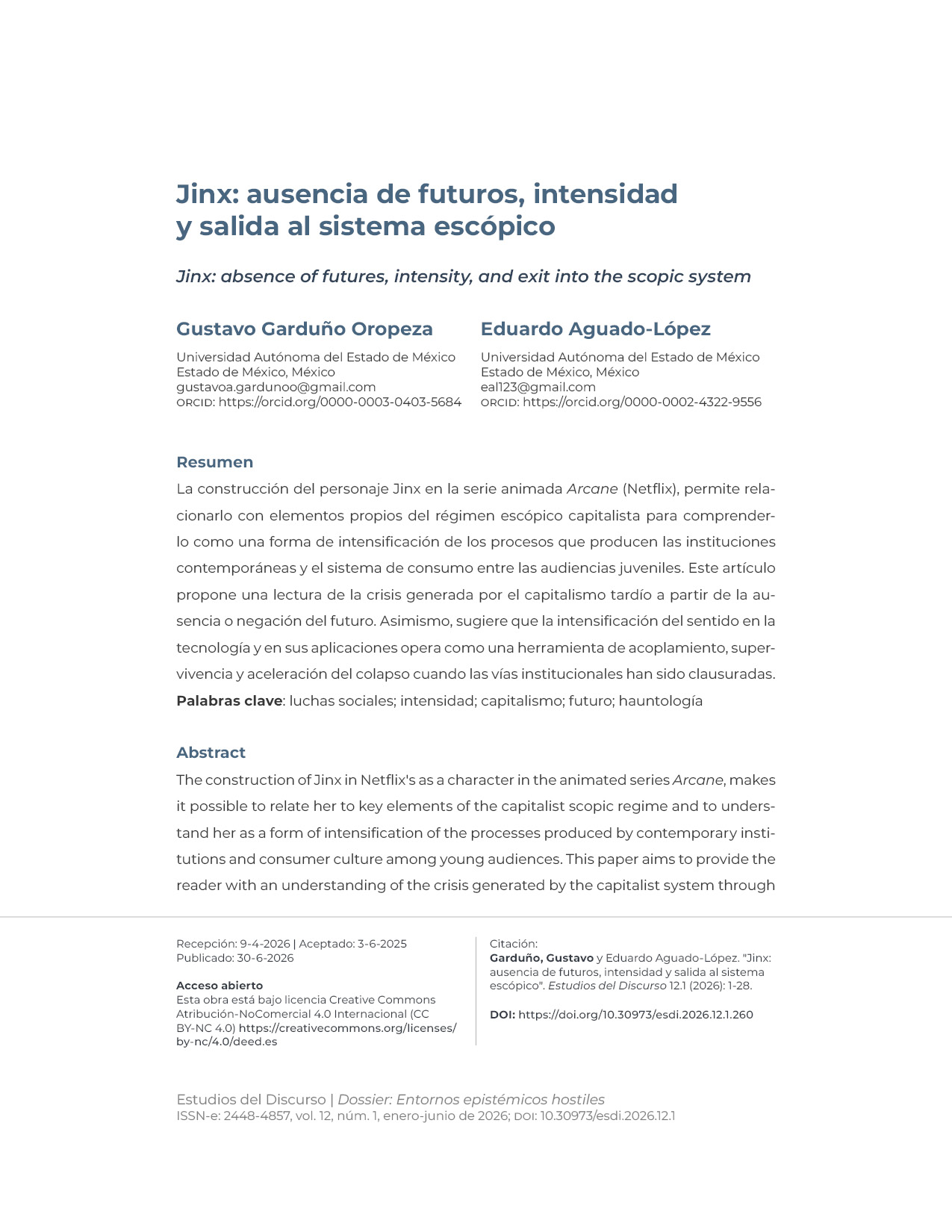
Jinx: absence of futures, intensity, and exit into the scopic system
DOI:
https://doi.org/10.30973/esdi.2026.12.1.260Keywords:
social struggles, intensity, capitalism, future, hauntologyAbstract
The construction of Jinx in Netflix's as a character in the animated series Arcane, makes it possible to relate her to key elements of the capitalist scopic regime and to understand her as a form of intensification of the processes produced by contemporary institutions and consumer culture among young audiences. This paper aims to provide the reader with an understanding of the crisis generated by the capitalist system through the absence or negation of futures, while suggesting that the intensification concerning technology and its applications functions as a tool for alignment, survival, and acceleration of the end when all institutional avenues have been closed.
Downloads
References
Beck, Ulrich. La sociedad del riesgo mundial: en busca de la seguridad perdida. Paidós, 2013.
Berardi, Franco. Héroes. Asesinato masivo y suicidio. Akal, 2017.
Bryson, Norman. “The gaze in the expanded field”. Vision and visuality. Bay press, 1988.
Cadwell, Tom y Oren Faz. League of Legends. Riot Games, 2019.
Charrue, Pascal, et al. Arcane. Netflix, 2021.
Crary, Jonathan. “Modernizing vision”. Vision and visuality. Bay press, 1988.
Deleuze, Gilles y Félix Guattari. Mil mesetas. Capitalismo y esquizofrenia. Pre-Textos, 2020.
Derrida, Jaques. Espectros de Marx. Trotta, 2012.
De Sutter, Laurent. ¿Qué Es La Pop-Filosofía? Cactus, 2020.
Espluga, Josep. “Ulrich Beck y las dimensiones sociales del riesgo”. Medi Ambient: Tecnología i Cultura, núm. 24, 1999, pp. 75-78, https://dialnet.unirioja.es/servlet/articulo?codigo=655212
Fisher, Mark. Los fantasmas de mi vida. Escritos sobre depresión, hauntología y futuros Perdidos. Caja Negra, 2017.
Fisher, Mark. Realismo capitalista. ¿No hay alternativa? Caja Negra, 2016.
Fisher, Mark. K-Punk, Volumen I. Escritos reunidos e inéditos (libros, películas y televisión). Caja Negra, 2019.
Fanon, Frantz. Los condenados de la Tierra. Ministerios de Trabajo, Empleo y Previsión Social, 1961.
Guattari, Félix y Gilles Deleuze. El Anti-Edipo: capitalismo y esquizofrenia. Paidós Ibérica eBooks, 1985.
Horkheimer, Max. Crítica de la razón instrumental. Trotta, 2002.
Jameson, Fredric. “Future City”. New Left Review, vol. 2, núm. 21, 2003, pp. 65–79, https://doi.org/10.64590/dwk
Jay, Martin. Downcast Eyes, 1993, https://doi.org/10.1525/9780520915381
Jay, Martin. “Scopic regimes of modernity”. Vision and visuality. Bay press, 1988.
Lyotard, Jean-François. “La condición postmoderna”. Dialnet, 1999, https://dialnet.unirioja.es/servlet/libro?codigo=197639
Lyotard, Jean-François. Libidinal Economy. Indiana University Press eBooks. Indiana University Press, 1993.
Mateo-Cecilia, et al. “Nómadas frente a parásitos: prácticas subversivas en la ciudad contemporánea”. Arte Individuo y Sociedad, vol. 30, núm. 1, 2018, pp. 9-27, https://doi.org/10.5209/aris.53080
Ramallal, Pablo Martín y Juan Ángel Jódar Marín. “Esports y espectacularización de eventos. El caso League of Legends”. Doxa Comunicación Revista Interdisciplinar de Estudios de Comunicación y Ciencias Sociales, núm. 38, 2024, https://doi.org/10.31921/doxacom.n38a1955
Riot Games. League of Legends, 2007. https://www.leagueoflegends.com/es-mx/
Rostow, Walt. Las etapas del crecimiento económico. Un manifiesto no comunista. Fondo de Cultura Económica, 1973.
Downloads
Published
Issue
Section
License
Copyright (c) 2026 DISCOURSE STUDIES

This work is licensed under a Creative Commons Attribution-NonCommercial 4.0 International License.
Since 2023, the journal has been published in open access under the CC BY-NC 4.0 Attribution/NonCommercial 4.0 International license, which allows you to share: copy and redistribute the material in any medium or format; and adapt: remix, transform, and build upon the material. Attribution: you must give appropriate credit, provide a link to the license, and indicate if changes were made. You may do so in a reasonable manner, but not in any way that suggests that the licensor endorses you or your use. NonCommercial: you may not use the material for commercial purposes.